AI-NATIVE SCIENTIFIC & ENGINEERING PLATFORM

FROM SCIENTIFIC EVIDENCE TO EXPERIMENTALLY VALIDATED ENGINEERING SOLUTIONS

Apexal connects scientific evidence, simulation, materials discovery, optimisation and experimental validation into a unified workflow for difficult physical-world engineering problems.

SYSTEMATIC, EVIDENCE-DRIVEN ITERATION

DISCOVERY FLYWHEEL

Apexal is being developed to connect scientific evidence, computational modelling, candidate design and experimental validation in an iterative discovery workflow. Evidence from validation can inform subsequent models, hypotheses and engineering decisions.


01

INCEPTION

QUESTION

Formulating precise thermodynamic and chemical inquiries based on emerging market requirements and theoretical gaps.

02

EVALUATE

EVIDENCE

Aggregating comprehensive literature, experimental baselines, and historical datasets to validate physical bounds.

03

FORMULATE

HYPOTHESIS

Establishing physical models and predicting empirical trends based on analytical, fundamental equations.

04

COMPUTE

SIMULATION

Executing transient multi-physics solver models on high-performance compute clusters to predict behaviors.

05

DRAFT

DESIGN

Converting refined physics models into exact, parametric physical architectures within high-tolerance CAD space.

06

FINE TUNE

OPTIMISATION

Applying algorithmic generative optimization to streamline thermal and structural metrics automatically.

07

EMPIRICAL

EXPERIMENT

Physical prototyping and laboratory trials under controlled environments with high-frequency diagnostic sensors.

08

CALIBRATE

VALIDATION

Correlating collected physical outcomes with computational telemetry models to quantify exact error margins.

09

EVOLVE

LEARNING

Synthesizing deep system insights back into foundational knowledge databases, triggering the next flywheel cycle.

EVIDENCE-DRIVEN DISCOVERY. CONTINUOUS IMPROVEMENT.

APEXAL PLATFORM

Connecting Scientific Discovery to Engineering Reality

Apexal is being developed to coordinate scientific evidence, computational modelling, materials exploration, design optimisation and experimental validation within a connected engineering discovery workflow. The platform is intended to help researchers and industrial R&D teams investigate complex physical problems, evaluate candidate solutions and connect computational insights with the requirements of real-world validation.

01 / Scientific Discovery

Turn scientific evidence into testable hypotheses.Scientific knowledge retrieval and physics-informed modelling approaches can help structure engineering questions, identify relevant evidence and define candidate hypotheses for further investigation.

02 /Computational Exploration.

Computational modelling, materials exploration and optimisation methods are intended to help assess candidate solutions, explore design trade-offs and identify promising directions for further evaluation.

03 / Engineering Reality

Experimental planning and validation workflows are intended to support comparison between model predictions and measured outcomes, helping researchers assess uncertainty, identify discrepancies and inform subsequent discovery cycles.

SYSTEM ARCHITECTURE

SIX-AGENT SCIENTIFIC ORCHESTRATION

A coordinated architecture designed to connect scientific evidence, computational modelling, candidate design, experimental planning, validation and continual learning within one iterative discovery workflow.

DISCOVER


Scientific evidence discovery, literature analysis and structured knowledge extraction to inform engineering hypotheses.

SIMULATE


Computational modelling across molecular, materials and multi-physics systems, with uncertainty-aware analysis where supported by the chosen methods.

DESIGN


Candidate exploration, parameter optimisation and constraint-aware evaluation of engineering trade-offs.

EXPERIMENT


Experimental planning, including design of experiments, constraints, sequencing and validation criteria for physical testing.

VALIDATE


Analysis of experimental data, uncertainty and differences between predicted behaviour and physical measurements.

LEARN


Use simulation and experimental evidence to inform model refinement, update design spaces and guide subsequent discovery cycles.

SYSTEM ARCHITECTURE

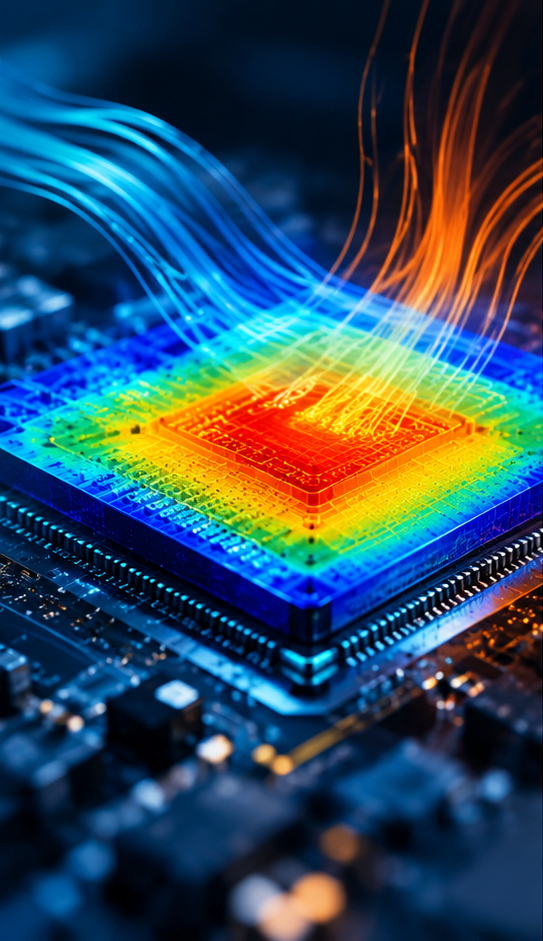
ADVANCED THERMAL & MULTI-PHYSICS ENGINEERING


Apexal applies scientific orchestration to demanding thermal and multi-physics engineering problems, connecting physical constraints, simulation, materials exploration, optimisation and experimental validation within a closed-loop workflow.

Request Technical Datasheet

APEXAL SCIENTIFIC ARCHIVE

RESEARCH

Access Apexal's research on autonomous scientific orchestration and AI-driven materials discovery. Our work is presented openly as preprints while research continues toward experimentally grounded validation.

TECHNICAL NOTICE: Preprints are preliminary reports of work that have not been certified by peer review. They should not be relied upon to guide formal commercial production or clinical standards without extensive validation.

PREPRINT / NOT PEER-REVIEWED

Closing the Sim2Real Gap through Autonomous Scientific Orchestration: The Apexal Architecture for AI-Driven Materials Discovery

Farayi L. Temera

Apexal presents an AI-native architecture for orchestrating scientific discovery across evidence gathering, hypothesis formation, simulation, design, experimental planning, validation and learning. The work focuses on closing the Sim2Real gap by connecting computational reasoning with experimentally grounded engineering workflows.

Download Preprint (PDF)
SYSTEM OVERVIEW

60-SECOND DEMONSTRATION

See Apexal's scientific orchestration workflow in action, from computational reasoning and simulation through engineering design and validation.

SCIENTIFIC & ENGINEERING ORCHESTRATION

HAVE A DIFFICULT PHYSICAL-WORLD PROBLEM?


Bring us a difficult physical-world engineering problem. Apexal provides a structured pathway from scientific evidence and computational exploration through design, optimisation and experimental validation.

Bring Us a Difficult Engineering Problem

FOUNDER & CEO

FARAYI L. TEMERA


Farayi L. Temera spent two decades maintaining mission-critical industrial equipment where material failure could stop production, increase operating costs and compromise reliability.

He saw firsthand how physical materials fail, including bearings, gears, hydraulic hoses, seals, gaskets and air systems, before transitioning from solving mechanical failures to applying AI and scientific discovery to difficult engineering problems.

Connect on LinkedIn